
Tarpon Springs Directory Years
The verified Tarpon Springs city directory record is not one unbroken shelf. The city's historic-survey bibliography names R.L. Polk editions for 1912, 1914 through 1916, 1918, and 1934. The FamilySearch catalog confirms combined Polk volumes for 1914, 1915, 1916, and 1918, and says no editions were published in 1917 or 1919. Other verified scans exist for 1931, 1937, 1939, 1941, 1944, 1947, and 1950. The exact physical run at the library and the final local print year are not published, so call before planning a visit around one year.
| Collection | Years | Where Held | Access |
|---|---|---|---|
| R.L. Polk city directories | 1912, 1914–16, 1918, 1931, 1934, 1937, 1939, 1941, 1944, 1947, 1950 | Library, FamilySearch, and verified scans | Onsite or collection-dependent |
| Tarpon Leader | 1916–1990 | Tarpon Springs Public Library Reference | Digitized on disk, onsite |
| High-school yearbooks | Several years; exact run unpublished | Library Reference | Onsite; ask for an inventory |
| Sanborn fire-insurance maps | 1909, 1913, 1919, 1926 | Library of Congress | Catalog and public digital images |
| St. Petersburg/Tampa Bay Times | 1901–2009 | Library ProQuest | Library-card access |
A year absent from that list should be treated as unverified, not guessed. The collection works best as a set of dated snapshots. A missing person might have moved, died, been skipped by the canvasser, or chosen not to be listed. A missing edition is a different problem. Bridge it with the Tarpon Leader, a released census, a yearbook, or another record created near the same date.
Tarpon Springs Library Research
The Tarpon Springs Public Library research desk is the main local access point. Reference holds city directories, high-school yearbooks for several years, local-history books, and the Tarpon Leader disk. Ancestry Library Edition is available inside the library. Fold3 is available with a library card, while the Florida Newspaper Database and ProQuest newspaper coverage broaden a surname search beyond city limits.
One-on-one genealogy help is available by appointment. Before visiting, give staff the person's full name, likely spelling variants, an approximate year, and any known address, school, church, or occupation. Ask which directory years are physically present. That short check prevents an assumed shelf run from becoming a false fact and lets staff point to microfilm, a database, or a local book when the printed volume is absent.
The library research portal shows its genealogy resources in one place.

The captured page helps researchers identify which newspaper, military, and genealogy databases require a card or an in-library visit.
Tarpon Leader Name Trail
The Tarpon Leader fills a special gap in local city directory research. Its verified 1916–1990 run can place a person in school news, club rosters, church events, business advertisements, legal notices, property reports, sports coverage, obituaries, and family announcements. These details can explain why an address or occupation changed between two directory editions.
Search more than one spelling and look at the page image, not only the text result. Older type and worn pages can confuse optical character recognition. Greek surnames are especially prone to variant forms. An address, spouse, occupation, or church link can show that two differently spelled entries describe the same person. The paper is evidence from its publication date, but claims about kinship or ownership still need support from vital, deed, or probate records.
Note: The library's local newspaper run begins soon after Pinellas County was created, making it a useful bridge across early twentieth-century sources.
Newspaper access is broader than the local disk. The library's ProQuest coverage of the St. Petersburg Times and Tampa Bay Times spans 1901–2009, while the Florida Newspaper Database adds titles from elsewhere in the state. Search the residence as well as the name. Legal notices and advertisements may print a full street line even when a news article uses initials. When a result is found, record the title, issue date, page, column, and exact spelling so another researcher can locate the same item.
Reading Tarpon Springs Directory Entries
A 1937 R.L. Polk entry can contain far more than a name. The Tarpon Springs alphabetical residents section appears on pages 217–258, while its street and avenue guide appears on pages 209–211. Polk said its data came from an actual canvass, but also warned about errors and omissions. Copy the entry exactly, including punctuation and short forms, then photograph or save the abbreviation page from that same edition.
| Name | Surname, given name, spouse, marital mark, and cross-reference where printed |
|---|---|
| Occupation | Trade and sometimes a related business address |
| Home | House number, street, and a residence, house, or boarding abbreviation |
| Occupancy notation | An edition-specific symbol may distinguish an owner from another listed occupant |
| Widow mark | “wid” followed by a deceased spouse's name can connect a family line |
- Criss-cross directory
- A reverse section arranged by street and house number rather than by surname.
- Householder index
- A street-order list of the person or business shown at each numbered address.
- Abbreviation key
- The edition's guide to short forms for marital status, residence, work, and business terms.
Do not force a modern meaning onto an old mark. In one edition, “r” may introduce a residence, while “bds” means boards. An owner or occupant symbol is useful only after checking that volume's key. Even then, it records what the publisher printed, not a certified statement of title.
Reverse Tarpon Springs City Directories
The street guide changes the question from “Where did this person live?” to “Who was listed at this address?” Streets are alphabetized, house numbers run in order, and intersecting streets can appear as landmarks. The 1937 guide also identifies householders and businesses. That makes it useful when a surname is unknown or spelled in several ways.
Start with the street name as printed then, not only its present form. Check the nearest numbered addresses and intersections when a house number is absent. A listed householder is not necessarily every occupant, and an unlisted house is not proof that it stood empty. For a current address-keyed search, use the Tarpon Springs street directory; the printed guide is the historical layer.
Tarpon Springs Greek Name Variants
Tarpon Springs changed quickly after mechanized sponge work drew Greek crews and families beginning around 1905. The city directory record can preserve both Greek and Anglicized given names, alternate surname endings, phonetic spellings, maiden names, and forms chosen by a canvasser. A strict exact-name search can split one life into several false identities.
Build a small variant list before searching. Compare each hit by spouse, occupation, address, church or community link, and nearby relatives. St. Nicholas Greek Orthodox Cathedral and community archives may preserve baptism, marriage, funeral, or organization records, but those are private religious holdings with their own access rules. The Tarpon Leader and Greektown historic records can supply public context without treating a similar surname as proof.
Tarpon Springs Maps and Occupants
The Library of Congress Sanborn collection includes verified Tarpon Springs editions from May 1909, October 1913, May 1919, and January 1926. A Sanborn sheet can show a building footprint, construction material, use, and later additions. It does not name the resident. Pair the map nearest in date with a Polk directory entry and a Tarpon Leader issue.
The official Greektown research method offers a good comparison: it combines plats, property-appraiser GIS, aerial views, Sanborn maps, and street images. Each source answers a different question. The map dates the structure and block form; the directory names a listed householder; the deed identifies title; the newspaper can show a household event. None should be made to stand for all four.
The Tarpon Springs Area Historical Society archives add photographs, family papers, school material, letters, maps, newspapers, and business files. Research at the Historic Train Depot is by appointment, with staff supervision and donor limits. Staff research is listed at $10 per hour; copy and scan fees vary by format.
The Historical Society archive page lists its supervised research service and collection rules.
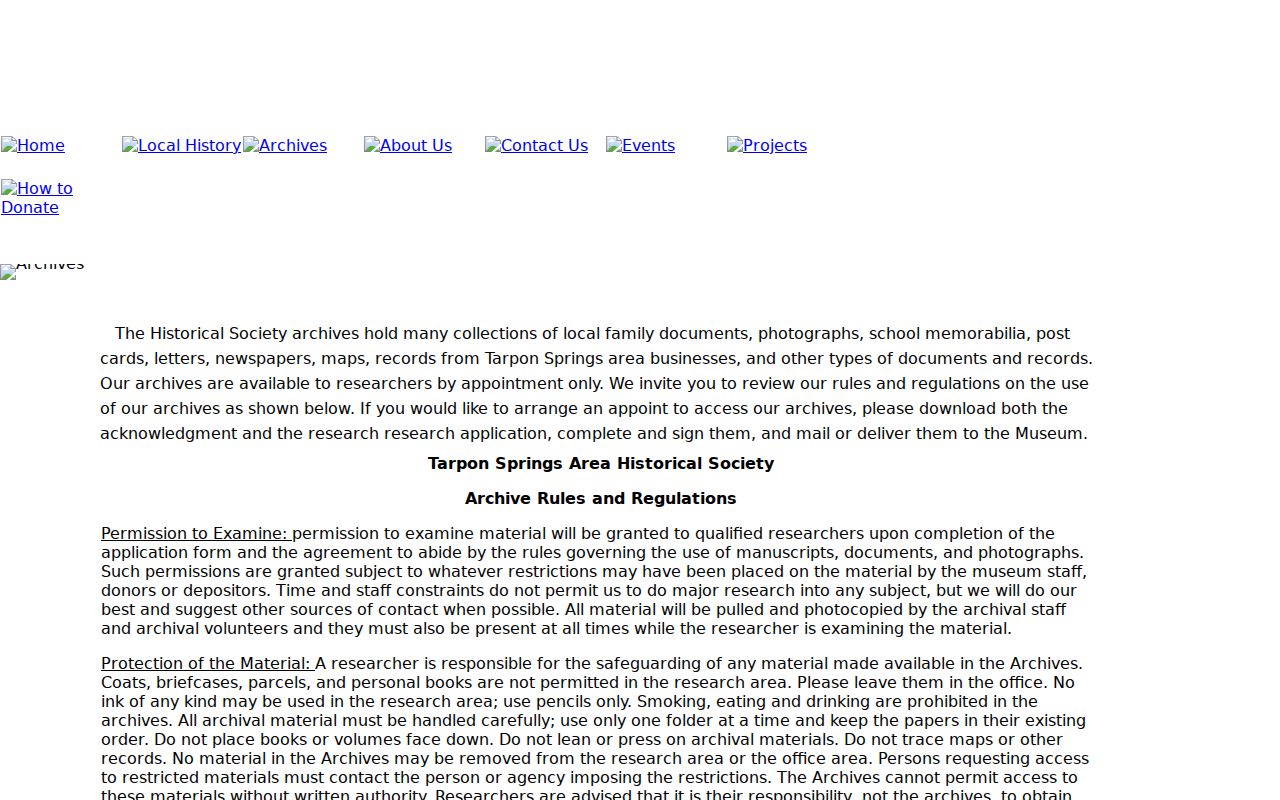
The archive view reinforces why a name, family, school, business, or address should be supplied before an appointment.
The FamilySearch Polk catalog verifies the combined directory volumes used to establish the early publication run.
Its catalog detail is particularly valuable because it explicitly records the editions present and the two years that were not published.
Trace Tarpon Springs Family Lines
A sound family trail treats each Tarpon Springs city directory as one dated observation. Begin with a year and person you already trust. Keep the exact entry beside its source page, then move one edition at a time. The sequence can reveal a move, spouse change, widow notation, new occupation, or a household that stayed at one address while ownership changed.
- Find one known name in the alphabetical residents list and save the full entry.
- Check the prior and next available editions, noting address, spouse, work, and spelling changes.
- Turn to the street guide to test whether the address stayed stable and who else was listed nearby.
- Pair 1940 and 1950 directory evidence with the released federal census schedules.
- Use newspapers, obituaries, cemetery records, deeds, or probate to explain the end of the trail.
The federal 72-year rule makes the 1950 census the newest public population schedule in 2026; the 1960 schedule is due in 2032. Census records can add kinship and age context, while city directories offer more points between census decades. Neither is flawless. If a person disappears, check the next newspaper years, the street listing, a death record, and nearby counties before deciding that the household left Tarpon Springs.
Yearbooks and church evidence can solve a different kind of gap. Library Reference holds high-school yearbooks for several years, though the precise schools and dates need confirmation. A class photograph or activity list can separate two people with the same name. St. Nicholas Greek Orthodox Cathedral and other community custodians may hold sacramental or organization records. Those are not public directories. Ask about access, explain the family-history purpose, and respect any limit the custodian sets.
For a modern confirmation after the historical trail, the Tarpon Springs resident lookup explains how to compare independent official indexes without merging people who merely share a name.