
Tarpon Springs Previous Resident Sources
No single collection spans the whole life of a Tarpon Springs address. Start with the source closest to the time in question, then use another kind of record to test the link.
| Source | Local coverage | Where held | What it contributes |
|---|---|---|---|
| PCPA parcel database | Current card with displayed histories | Property Appraiser | Owner, situs, mailing, legal, last deed |
| Pinellas Official Records | Index 1957 to present; images generally 1970 to present | Pinellas Clerk | Recorded owner chain and legal description |
| Older deeds | Pinellas from 1912; Hillsborough chain before creation | Clerk rooms, archives, microfilm | Earlier transfers |
| R.L. Polk directories | Verified selected editions from 1912 through 1950 | Library, FamilySearch, scans | Listed adults, address, work, spouse notation |
| Tarpon Leader | 1916 through 1990 | Library Reference disk | Residents, deaths, businesses, address events |
| Federal census | Public schedules through 1950 | Genealogy databases and NARA | Households at ten-year points |
| Permits and Sanborn maps | Record and edition dependent | City, Library of Congress | Building changes, footprint, use |
Owners and occupants are not the same category. Deeds ordinarily identify people with an ownership interest. Directories, newspapers, and census records can add past residents who never owned the parcel.
Start the Tarpon Springs Trail
Open the PCPA parcel search by address. Save the parcel number, site address, owner, mailing address, subdivision, full legal description, plat book/page, sale history, and last deed book/page. This card fixes the identity of the land before the previous-resident search moves into older indexes.
Mailing and situs must stay separate. Situs locates the land; mailing locates the tax-contact destination. An out-of-area mailing address does not prove the house was empty, and a matching address does not identify every occupant. Homestead can strengthen an owner-occupancy inference, but remains incomplete household evidence.
The modern parcel stage is covered in more field detail by the Tarpon Springs street directory. Here its purpose is narrower: establish the first deed and stable land description for one backward trail.
Reverse the Pinellas Deed Chain
The last-deed citation leads to the Pinellas Clerk Official Records search. Copy facts exactly. A name match alone is weak; the legal description should remain consistent as the chain runs backward.
- Open the current deed and record buyer, seller, legal description, execution date, recording date, instrument number, and prior reference.
- Search the seller as a grantee before that sale date.
- Match the legal description, then open the deed by which that seller acquired the land.
- Repeat the seller-to-earlier-buyer move. Use mortgages only as supporting identity evidence, not as transfers.
- At the online cutoff, request the older index, image, or book through the Clerk counter and microfilm channels.
- Grantor
- The party transferring an ownership interest.
- Grantee
- The party receiving that interest.
- Chain of title
- The linked sequence of ownership transfers for the same land.
- Legal description
- The recorded words that identify land more reliably than a street address.
Clerk Recording Services answers at 727-464-4876. The North County Branch at 29582 U.S. 19 N is the closest broad Clerk counter. Online unofficial prints are free; certified copies and staff searches follow the Clerk fee schedule.
Tarpon Springs Records Cross 1912
Pinellas County was created from Hillsborough County in 1912. That boundary is a hard archival turn in a long Tarpon Springs chain. A modern parcel can have an earlier deed filed in Hillsborough books even though the land now sits in Pinellas. Apparent silence near that year does not prove a break in ownership or a destroyed file.
Keep following the legal description, plat, and party sequence. Ask the Pinellas Clerk which predecessor citation appears in its earliest county instrument, then continue through Hillsborough records, archives, or FamilySearch as needed. Research found no major courthouse fire that explains the gap. County creation, indexing, retention, and digitization are the supported explanations.
Note: Write the county name beside every pre-1912 citation so similarly numbered deed books are not confused.
Find Tarpon Springs Past Households
Once deeds establish owners, directory and census evidence can identify listed occupants. The Tarpon Springs Public Library holds city directories and high-school yearbooks for several years. Verified R.L. Polk editions include 1912, 1914 through 1916, 1918, and 1934, with additional known scans for 1931, 1937, 1939, 1941, 1944, 1947, and 1950.
A reverse, or criss-cross, section arranges entries by street and number. Alphabetic entries may show an adult name, spouse, occupation, address, and an owner or occupant mark. Fields vary by edition, so read that volume's key. An absent name never proves that a person moved.
- Choose the directory closest to the deed or event date.
- Check both the street section and alphabetic name entry.
- Copy spelling, spouse notation, occupation, and address exactly.
- Compare adjacent available editions for changes.
- Pair 1940 or 1950 directory evidence with the matching released census schedule.
The 1950 census is the newest public population schedule as of 2026 under the 72-year rule. It can show a household at a point in time, not continuous residence between census days.
Tarpon Leader Finds Previous Residents
The library's digitized Tarpon Leader run covers 1916 through 1990 on disk in Reference. It can fill years when no directory edition is at hand. Search a surname, full street address, business name, school activity, legal notice, obituary, and spelling variants. Older print and OCR often misread Greek surnames.
Access is local, not a public web index. A failed internet search therefore says nothing about whether the newspaper contains the name. The Tarpon Springs Public Library research desk also offers historical newspaper databases, Ancestry Library Edition onsite, Fold3 with card access, and genealogy appointments.
Greek and Anglicized name forms deserve separate searches. Mechanized sponge work and Greek migration reshaped Tarpon Springs beginning around 1905. Address, spouse, occupation, and church or community ties help distinguish families whose names were transliterated in several ways.
Date a Tarpon Springs House
Residents and buildings follow related but different timelines. City permit records may show construction, additions, roof finals, certificates of occupancy, elevations, plans, owners, applicants, contractors, and inspections. The City Clerk accepts requests by phone, email, walk-in, or optional form. A narrow request should include the address, parcel if known, approximate date range, and exact record type.
Sanborn fire-insurance maps show footprint, construction material, use, and additions, not occupant names. Library of Congress catalog records exist for Tarpon Springs editions from 1909, 1913, 1919, and 1926. Pair the closest Sanborn map with a directory and deed rather than reading a building outline as proof of residence.
The official Greektown map models this method by reconciling plats, aerial imagery, PCPA GIS, Sanborn evidence, and street imagery. Its labeled addresses and contributing resources help bridge modern and historic parcels.
Tarpon Springs City Record Fallback
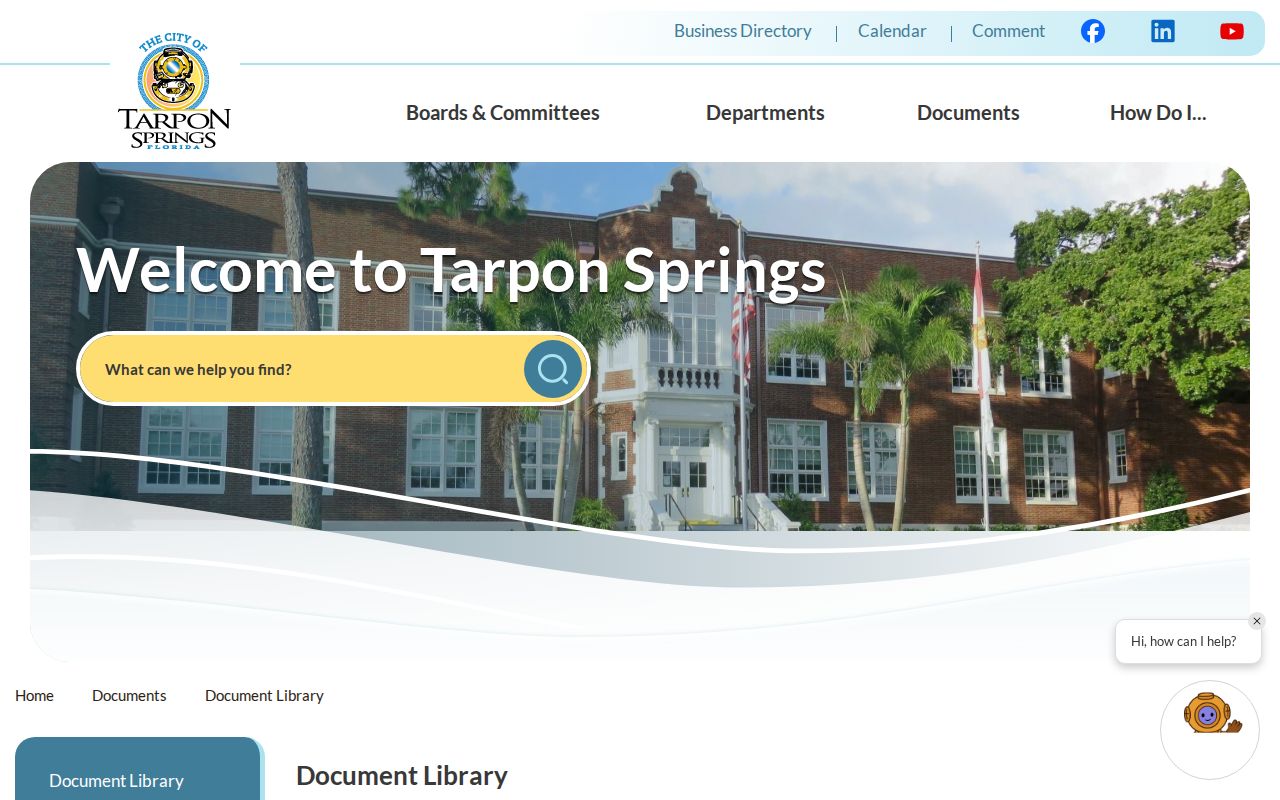
The Tarpon Springs Document Library provides forms for records, assessments, building, zoning, and cemetery matters. It is useful when a prior-resident trail reaches a city-created permit, code case, assessment, or burial clue rather than a county deed.
See the city's document access page pictured below.
Cycadia Cemetery has no official public name-search database identified in the research. For burial or cemetery deed evidence, contact the cemetery or Clerk with the full name, approximate date, and lot or section when known.
Archives Extend Tarpon Springs Trails
The State Archives of Florida and Florida Memory can add maps, photographs, manuscripts, and government series. The Tarpon Springs Area Historical Society holds family papers, school memorabilia, letters, newspapers, maps, and business records at the Historic Train Depot. Society research is by appointment and subject to staff supervision and donor limits.
Open the State Archives access page shown below.

Use archive material as dated evidence. Captions, donor notes, and family accounts may point to a past resident, but deeds, directories, census entries, or newspapers should test the identity.
Close a Tarpon Springs Resident Trail
When an owner dies, probate and obituary evidence can explain why the next deed names an estate, personal representative, or heir. Search the Pinellas court index by decedent name, read the case chronology, and then follow any recorded estate deed. Restricted beneficiary or minor information stays outside the public trail.
Obituaries in the Tarpon Leader or library newspaper databases can connect relatives, prior addresses, funeral details, and burial. They are most useful when paired with the probate case and deed, since name spellings and family summaries can vary.
Lawful use. Research previous residents for genealogy, house history, estates, and personal curiosity, never to harass or track a living person.
A good stopping point is a supported statement with source dates, not a guess about every person who occupied the home. Preserve conflicts instead of forcing them into one story.